We are all familiar with the 1916 Easter Rising in Ireland and the trends and tribulations that followed which ultimately secured our independence as a nation. But, we’re not here to talk about the rising, we’re here to talk about the hiring in 1916. In particular, the hiring trends, the type of jobs available, women in work and wages in Ireland in that period. What follows is a summarised accumulation of articles written on the topic, secondary research, stories and accounts from various public sources including the CSO, newspapers and more during that time.
The job opportunities in the newspapers of 1916 were extremely different to today, as space was a premium, the cost of printed paper was relatively astronomical when compared to today and papers were rarely larger than 8 pages. Job ads as a result were confined to no more than 10 lines of small print. Most advertisements required applicants to send their applications through to a specific Box number and the variety of jobs on offer was hugely different to 2016.
There was a huge demand for private servants and grocery assistants. Other jobs advertised were for van drivers, cabinet makers, yardmen (to mind farm animals), butter makers, sewing machine sales, dental mechanics, book-keepers, drapery assistants and bar personnel. However what stands out with a large proportion of these job ads is that the age, gender, religion and strength of preferred applicants are clearly stated.
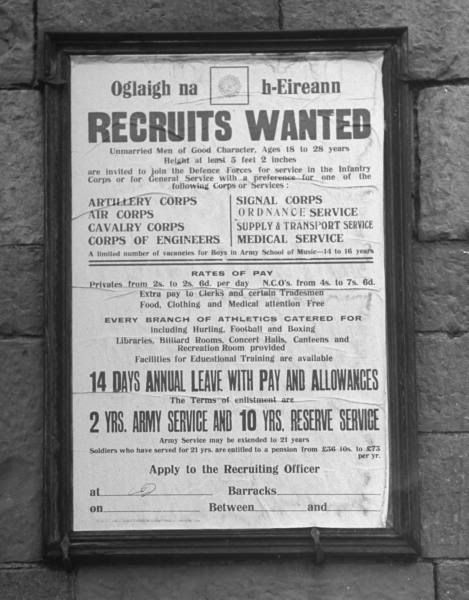
A typical ad of the time is illustrated below. On the eve of the centenary of probably the most iconic and transformative events in Irish history. It's interesting to look back in time from a job seeker's perspective in 1916.
You may be surprised to learn that in 1916 Ireland was experiencing a period of economic prosperity. This was due mainly to the positive economic effects of the First World War.
The Irish economy at the time was dominated by four industries:
The first three of these activities were positively impacted upon by the war with increased demand for food, linen and ships directly linked to the war effort. We must note that this prosperity was not shared by all sectors of society with many people in Ireland experiencing very poor living conditions.
Dublin was a city of extremes in housing in 1911, when 22% of dwellings were large homes (with 10 or more rooms) and 36% were one-room tenements.
The Irish economy in 1916 was by no means industrially backward. Ireland was in the group of middle-ranking industrialised countries along with Portugal, the Scandinavian countries, Italy and the Netherlands.
In 1911 there were 1,273,850 people at work which had grown to 1,807,360 in 2011. In 1911 nearly half of all workers were in agriculture and Just over a quarter (26.8%) of workers in 1911 worked in manufacturing and construction jobs and one in ten workers in 1911 worked as domestic servants.
The Professional group of occupations in groupings of Professional, Technical and Health workers and Clerical, Managing and Government workers accounted for 8.8% of all workers in 1911. The Commercial group of occupations in 1911 covered 5.6% of workers and included Insurance, Banking, Transport and Communications, and Retail and Wholesale trade.
In the labour market by 1916, an estimated 130,000 to 150,000 men from Ireland had joined the British army. In addition, considerable numbers of both men and women went to Great Britain to work in munitions factories and hospitals. There was also work provided in Ireland in the servicing of army camps and bases.
The 1900’s marked a new beginning for those Irish women who sought women’s suffrage, better educational opportunities, better working conditions and who supported nationalism. Inghínidhe na hÉireann (Daughters of Ireland), was founded by Maud Gonne in 1900 and represented both nationalism and feminist ideals. In 1907 Sinn Féin admitted women as members. In 1911 the Irish Women’s Workers Union was founded by Delia Larkin, sister to James Larkin, because other trade unions of the time excluded women.
There was a strong involvement by women in the 1916 Rising who represented a cross-section of Irish society. Single and married women were involved as well as women from different religious denominations and they included an actress, a doctor, shop-assistants and seamstresses. They trained in first aid, drill signaling and rifle practice. During the Rising itself women were involved in the most dangerous areas, - carrying explosives, dispatches and ammunition. Some worked as nurses and cooks, although members of the Citizen Army were armed and a number of them took part in the fighting.
More Irish girls and women than ever before, of all social classes, were leaving home regularly to take part in some kind of public life – work, schooling, buying and selling, activism and entertainment. Trades of all kinds struggled against the ready-made goods in shops, but female dressmakers and milliners (often working for and in drapery shops) held their own, as demand for reasonably priced, fashionable women’s clothes soared.
While factory workers and servants saved their finery for their time off, teachers, nurses, secretaries, clerks in offices, telegraphists and telephonists needed to look presentable all day, every day. Their numbers rose dramatically in the quarter-century before the First World War.
National school teaching was a great career opportunity for girls from skilled working-class and small-farming backgrounds in Ireland. On-the-job training was sometimes paid, and scholarships increasingly available, so the burden on low-income parents was bearable. The first female president of the Irish National Teachers’ Organisation (1912-14) was Catherine Mahon from Birr; her parents were domestic servants.
Nursing was another lifelong career opportunity; a trained nurse could work in a hospital or on a private basis in the community, or for the Poor Law Union or Lady Dudley or Jubilee nursing associations. Women in jobs like these were the backbone of the cultural, political and social organisations that sprang up all over the country from the 1890s.
Women’s factory work was mostly concentrated in the spinning mills and weaving and shirt factories of Belfast and Derry, which employed tens of thousands of women. Textiles also employed Munster women, though on a much smaller scale; the main factory employment of women outside Ulster was food processing of various kinds – biscuit-making, confectionery, jam-making and butter-blending. Meanwhile, “monster houses” (department stores) in cities and towns hired attractive and well-spoken young women as sales assistants.
They usually lived-in, in dangerously cramped dormitories, and were on their feet for 12-hour days with only short breaks – but considered their jobs more desirable than domestic service.
Sugar rose from 2½ pence per pound to 6 pence; butter from a shilling per pound to a shilling and sixpence; flour increased by 20%, bacon by 25%. Rents also increased, as did luxuries.
In general, the cost of living increased by about 50% in the first two years alone of the Great War, and continued rising thereafter. The Cork Examiner cost a penny at the outset of the war, remaining there until January 1918, rising then to ‘Three Halfpence’. Rising prices led to widespread industrial unrest in Britain. In July 1915, the government conceded to postal workers a war bonus of four shillings per week to men, and two shillings per week to women.
By 1916, pressure from various representative bodies in the public services (unions in all but name) ensured the bonus passed onto Irish public servants. The primary teachers’ body, INTO, negotiated equal payment for its female teachers. Fully established primary and secondary teachers earned about £100 to £150 per annum, a rate compared not unfavourably with some engineers. For example, Seán MacEntee left Belfast in 1914 to work for Dundalk council as engineer for £100 salary, according to his biographer Tom Feeney.
Labourers had a brief spell of increased earnings. The Agricultural Wages Board set minimum labourer rates at 19 to 24 shillings per week in 1917, by which their incomes and those of all industrial labourers lagged far behind price increases. But their good fortune ran out in 1921 when the government repealed the 1917 Corn Production Act that guaranteed minimum prices. Agricultural prices slumped as a result and wage levels went into freefall.
Despite poor earnings in agricultural labour, the lure of a shilling a day (£18 per annum – if one survived) was not sufficient to drive rural army enlistment.
One thing that is clear throughout my research, is that the jobs that our ancestors performed were hedged entirely around family concerns and constraints which is still very similar to this day.
By Andrew Sheehan
 Andrew is the Marketing Manager at RECRUITERS. Read more about Andrew on his bio page.