It's interesting to look at the evolution of the office over time. It's true the workplace is a very different place to what it used to be 30 years ago, but it's also very different from what it was just six months ago. What could it possibly look like in 30 years to come?
Let's take a quick trip down memory lane:
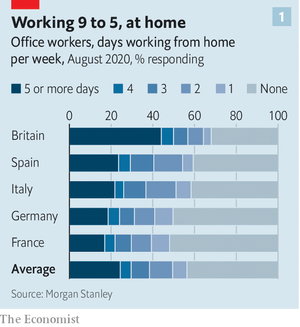 The preliminary results do not, by themselves, mean the end of the office as we know it though. However, it does mean that there is a live debate to be had and employers need to consider what they are going to do about their office space, fast.
According to the Economist, the latest data from August 2020 suggests that only 50% of people in five big European countries spend every work-day in the office. A quarter remain at home full-time.
In August 2020, RECRUITERS conducted a survey with more than 4,000 C-suite professionals, directors, business owners and managers in Ireland on the future of work in response to Covid-19. Despite, planning for a staggered return, smaller workgroups and shifted hours in response to COVID-19, 85% of respondants have not officially discussed reducing office space in 2021.
Only 36pc of respondents said they envisage having more than 80% of their workforce back in the office in January 2021.
89% of respondents are planning to split their workforce hours between home and the office with just 11% planning on full working weeks in the office.
20% of respondents still “don’t know” when they will have more than 80% of their workforce back in the office, owing to the level of continued uncertainty in workforce planning.
Yet only 15% of respondents have formally met at a Management level to discuss reducing their office space.
Our attitudes and opinions of working from home have dramatically changed since March 2020. On the topic of remote work productivity, results from our survey found that:
This is really interesting because when RECRUITERS conducted a similar survey just before lockdown, more than half (52%) of respondents predicted a decrease in productivity if their workforce must work from home for a sustained period.
This dropped to just 9% predicting a decrease in productivity if we must work from home for a sustained period in our August 2020 survey. In fact, 39% of respondents now expect productivity to increase!
Companies are recognizing this in conjunction with the fact that many employees will want to keep working from home after the pandemic. In September, Google abandoned their plans to rent office spaces in Dublin's Docklands for 2,000 employees. On August 28th, Pinterest paid $90 million to end a new lease obligation in San Francisco.
RECRUITERS' survey found that the vast majority (89%) of respondants said they expect more remote working opportunities after the return to the office, with only 11% saying their workforce will need to work full weeks in the office when they return.
Surely Covid-19 is killing the office then, right? Wrong. Many employers are keen to start encouraging their staff back into the workplace. A return to office brings about many perks, including social inclusion, better workplace collaboration, separation of home life and reinforcement of company values. Bloomberg is reportedly offering a stipend of up to £55 a day to get its workers back to its building in London.
However, there is still a lot of uncertainty as to when our workplaces will be at full capacity again which is resulting in decisions about upsizing or downsizing our workplaces in the future being kicked down the road.
The recent return to the office has brought on a new type of office experiment whereby some of us are in the office some of the days. Employers in Ireland, and across the world, have done a great job of merging the perks of office life with what people have been enjoying about working from home, for example, flexi-hours, a relaxed atmosphere, avoidance of busy commute times and staggered days in the office.
This hybrid approach still leaves both employees and employers in limbo. It means employees still need to be within a commutable distance to the office and employers still need to pay for office space and everything that goes with that. When everyone was working from home, there was a sense of 'we're all in this together'. Everyone knew what was going on and what had to be done.
Right now, the hybrid approach appears to be working. So to did the open-plan office until recent research started to show us that it wasn't from a productivity point of view.
However, if we keep seeing increases in workforce productivity from home combined with the merging of perks and management of staff from home, the need for large office spaces in city centres will be questionable. For how long can we continue to eat our cake and eat it too?
Have we inadvertently gone back to the 1980's cubicle style of working? Instead of an open-plan office, we now all work in an open-plan economy but our homes have become the cubicles within it.
Despite all of the evidence and survey results that show that working from home has boosted people's productivity and happiness, it's probably too early to tell if this can last for a sustained period of time. The way things are going, Covid-19 certainly does have the potential to kill the office.
However, winter is coming and with that comes shorter days, cold weather, and a longing for interactions and distractions with friends and colleagues to help get people through it. It's all well and good in the summer months when the mornings are bright and the weather is nice enough to enjoy a morning (or evening) stroll when we're working from home. Unless we're forced to leave the house, many might not continue this during the winter which could cause serious health issues - physically and mentally.
Yes, companies need to embrace the new world of working. In so doing, they stand to save a lot of money on traditional office expenses and potentially benefit from increased workforce productivity going forward. However, employees working remotely also need to be careful of what they wish for. If we let Covid-19 kill the traditional office workplace in the future, we will also kill everything we loved about the office, the routines that got us out of the house and the warm welcoming coffee shops that we looked forward to visiting every day.
I hope it never comes to that. Bring on the vaccine!
Written by Andrew Sheehan
 Andrew is the Marketing Manager at RECRUITERS.
Blog image designed by Adam Allsuch Boardman, cited in The Economist 09/09/20.